

Report #1: Statewide Summary
A Survey of Individuals and Families Living with Autism
Needs Assessment Statewide Summary Overview
The Bureau of Autism Services, in its effort to improve care and quality of life for Pennsylvanians with autism and their families, conducted the PA Autism Needs Assessment. This effort has been a key task of the ASERT (Autism Services, Education, Resources and Training) Collaborative and has been led by University of Pennsylvania School of Medicine, Center for Mental Health Policy and Services Research and the Center for Autism Research at The Children’s Hospital of Philadelphia.
Autism Spectrum Disorders (ASD), referred to as autism throughout these reports, include Autistic Disorder, PDD-NOS, Asperger’s Disorder, Childhood Disintegrative Disorder and Rett’s Disorder. With more than 3,500 responses, this is the largest and most comprehensive survey of individuals with ASD and their caregivers to date in the nation. The findings from this needs assessment highlight challenges that Pennsylvanians with autism, of all ages, face everyday.
This overview provides a summary of the Needs Assessment findings from each of the topic reports listed below. This Statewide Summary does not include the recommendations that are included in each report; however, a summarized list of all the recommendations is available (see Needs Assessment Report Recommendations).
The reports represented in this summary are as follows
Report #2. Service Needs
Report #3. Barriers and Limitations to Accessing Services
Report #4. Unwanted Outcomes: Police Contact and Emergency Hospital Care
Report #5. Getting a Diagnosis and Follow-Up Care Report
Report #6. Employment Challenges Report
Report #7. Family Impact
KEY FINDINGS
- Pennsylvanians with autism of all ages and their families are struggling to find the services they need and are often dissatisfied with the services that are provided.
- As individuals with autism grow into adulthood the needs for supports and services often increase, although services become more difficult to access.
- A lack or shortage of providers is the most common barrier to accessing services.
- The lack of effective interventions for challenging behaviors and mental health problems often lead to preventable crises.
- Although children are being diagnosed at younger ages, diagnosis and follow-up care is still a long and difficult process.
- Most adults with autism are unemployed or underemployed because the necessary supports are not available.
- Caring for an individual with autism takes an economic and emotional toll on families.
Why a Survey?
The number of individuals in Pennsylvania diagnosed with an autism spectrum disorder, referred to as autism in this report, has risen dramatically in the last 20 years. The Pennsylvania Autism Census Report estimated that 25,000 individuals would be living with autism in Pennsylvania in 2010. To understand the changing needs of the expanding and aging autism population, the Pennsylvania Department of Public Welfare, Bureau of Autism Services (BAS) commissioned a survey to assess how or if the needs of individuals with autism and their families are met. The information collected from the survey is intended for policymakers, service providers, community organizations, and advocacy groups to better understand and address the needs of individuals affected by autism in Pennsylvania.
Who Answered the Survey?
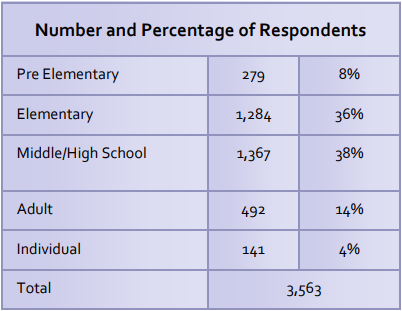
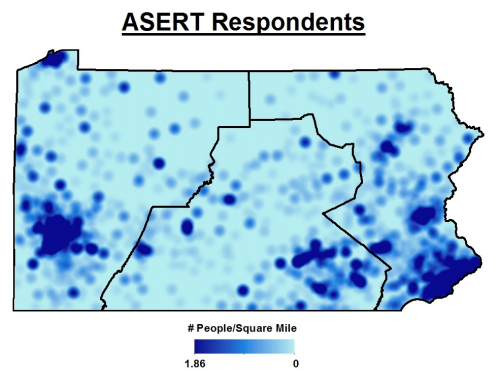
3,563 caregivers and individuals with autism completed the survey. Four survey modules were developed to capture differences across age groups. Individuals with autism over age 18 could complete a separate survey.
- The median family income among the caregivers who responded to the survey was similar to the median income for all Pennsylvanians ($51,000).
- The majority of caregivers who responded had at least a high school degree or GED, and more than half had at least a four-year college degree.
- The individuals with autism for whom caregivers completed the survey about were 80% male.
- 2 out of 3 individuals with autism had at least one sibling, and one in 10 of these siblings were also diagnosed with autism.
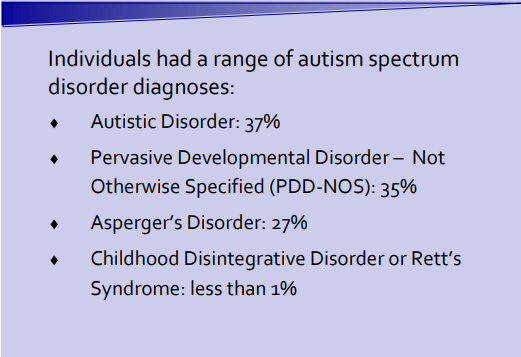
Adults who responded for themselves:
- Averaged 25 years of age and 75% were male.
- Most (70%) were diagnosed with Asperger’s Disorder.
- Almost all had completed high school.
- 1 in 3 had also completed at least some college.
Report #2: Service Needs
Individuals with autism and their families need a range of services to live as independently as possible, participate in their communities and enrich their quality of life. This report looks at whether Pennsylvanians living with autism are getting the services they need, identifies barriers to accessing services, and examines if the families of individuals with autism consider the services they do receive to be effective. Pennsylvanians with autism and their families are struggling to find the services they need and are often dissatisfied with the services that are provided. These challenges increase as individuals grow into adulthood.
85% of individuals with autism have a co-occurring disorder, complicating the amount and type of services they need.
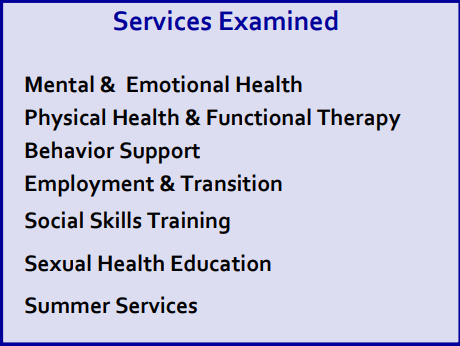
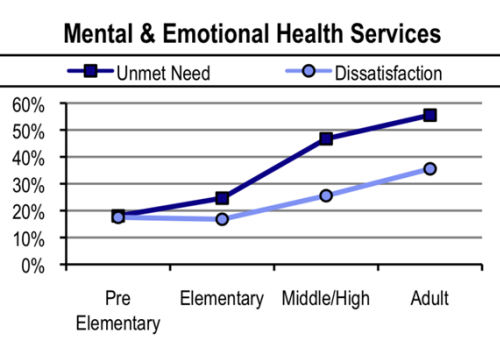
- Unmet needs for, and dissatisfaction with, services increase as individuals get older.
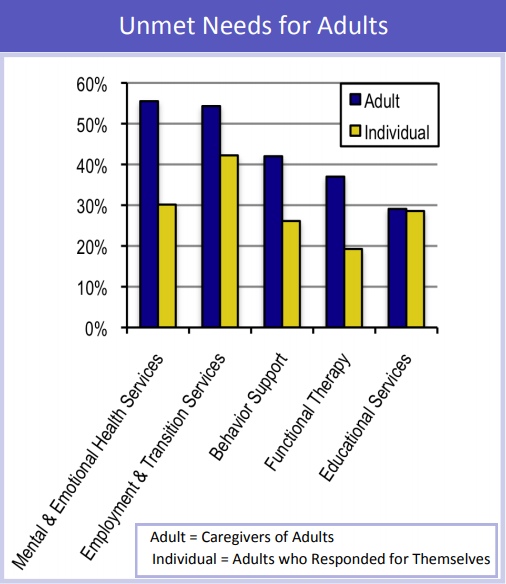
- The unmet need for mental health services substantially increases with age because of both increasing need and a lack of available services.
- Caregivers of adults most often reported that physical health and functional therapy services were ineffective.
- Unmet need for services for aggressive behaviors nearly doubles as individuals with autism age into adulthood (15%).
- Social skills training is among the most commonly reported unmet needs.
- Close to half of caregivers of students in middle and high school, and 1 in 3 adults, report an unmet need for transition services.
Report #3: Barriers and Limitations to Accessing Services
Individuals with autism and their families face multiple barriers to accessing services. Identifying and describing these barriers are critical steps in improving the systems that serve individuals with autism and their families. This report describes the barriers to accessing services for primary care, dental care, specialty health and education services, and family support services for individuals with autism and their families.
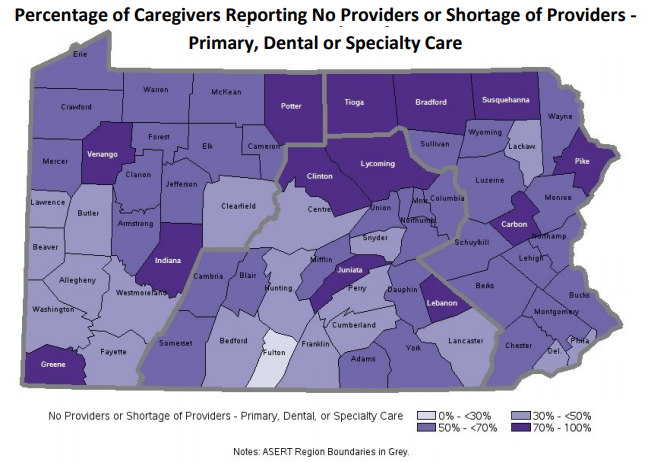
- A lack of or shortage of providers was the most common barrier for all services and was worse in rural areas, and in regard to adult services.
- Almost 1 in 5 report cost or lack of insurance as a barrier to receiving specialty health and education services.
- Caregivers face difficulty finding providers who understand autism and have the training required to address the needs of an individual with autism, particularly adults with autism.
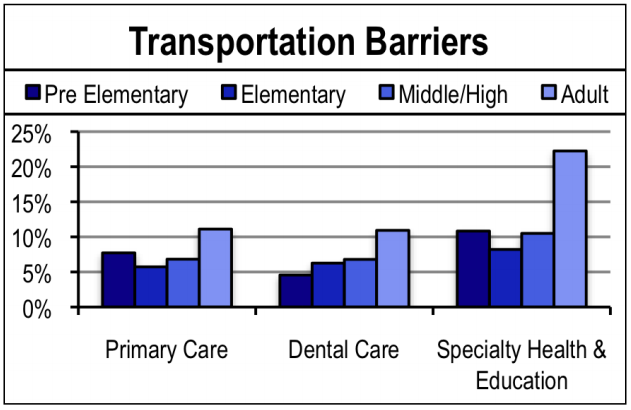
- Twice as many caregivers of adults with autism, as compared to caregivers of younger children, report transportation as a barrier to accessing services.
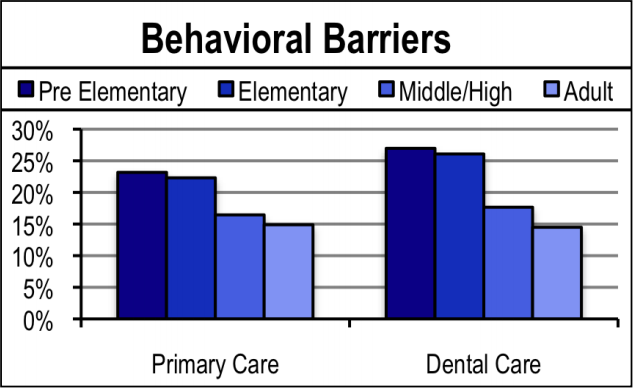
- Behavior challenges are the most common barrier to accessing primary and dental care services, particularly for younger children.
Report #4: Unwanted Outcomes—Police Contact & Urgent Hospital Care
Both the untreated or undertreated symptoms of autism and co-occurring disorders can result in unwanted outcomes including police contact, emergency room visits, and inpatient psychiatric hospital care. These experiences are traumatic and costly for individuals with autism and their families, and could be prevented or addressed more effectively and cost-efficiently through community-based services. This report looks at the contact that individuals with autism have with police, and their use of emergency hospital-based care.
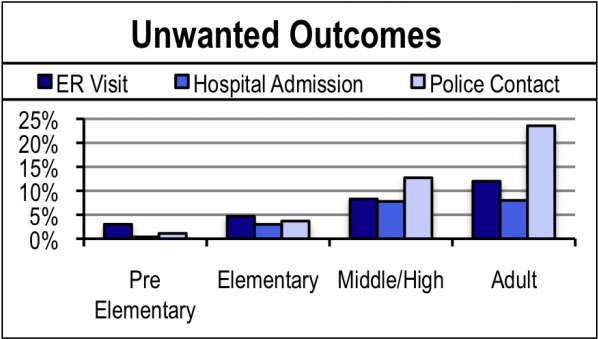
- As individuals with autism age, they are increasingly likely to have police contact.
- 50% of individuals who had police contact were hospitalized at some point.
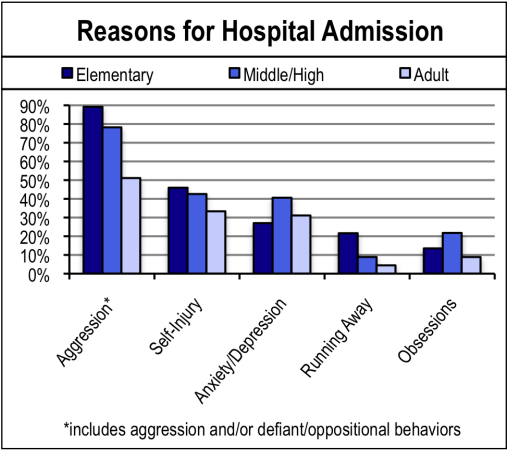
- Aggression is the most common reason for hospitalization.
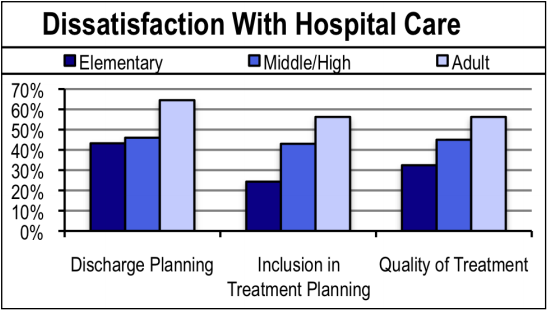
- Over half of caregivers of adults report dissatisfaction with discharge planning, inclusion in treatment planning, and quality of treatment.
Report #5: Getting an Autism Diagnosis and Follow-up Care
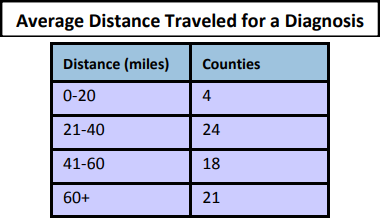
Community awareness of autism has increased exponentially in the last two decades. As a result, caregivers notice developmental delays earlier and professionals diagnose autism in children at a younger age. Even so, autism diagnosis and follow-up care is often a long and difficult process. Receiving a diagnosis and services earlier in life results in better outcomes. This report addresses the process of getting an autism diagnosis and follow-up care in Pennsylvania.
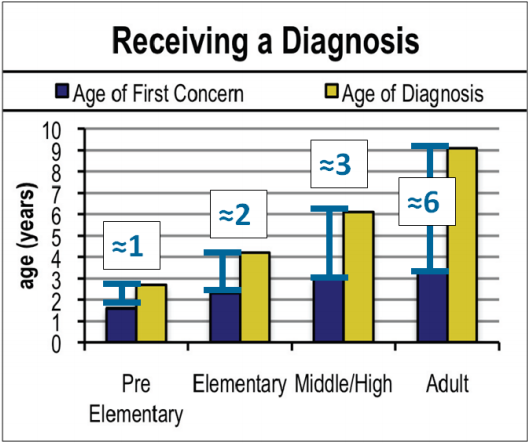
- There is a six-year difference between the age when individuals in the adult group were diagnosed and the age when individuals in the pre-elementary group were diagnosed.
- The gap between first concern about development and age of diagnosis has decreased over time.
- Even for the most recently diagnosed children, there was a gap of more than a year from when a caregiver first noticed a delay in development until their child received an autism diagnosis.
- Adults were most likely to have received multiple prior diagnoses before receiving an autism diagnosis.
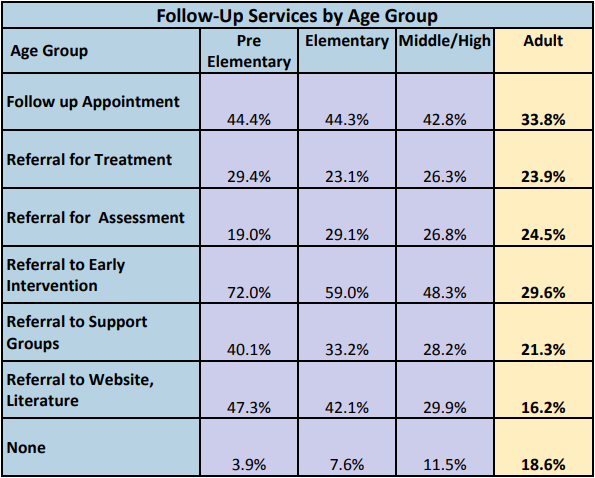
- Referrals to follow-up services post-diagnosis have increased over time. Still, less than half of families of pre-elementary school children are referred to treatment or follow-up appointments.
- Caregivers of adults consistently report fewer referrals to follow-up services than other age groups, with almost 19% reporting no referrals at all. Certain services, such as websites, literature and support groups, may not have been available when adults with autism were first diagnosed.
Report #6: Employment Challenges
Finding and maintaining employment is a critical component of improving quality of life. Although many individuals with autism are fully capable of working, most are unemployed or underemployed because the necessary support services are not available to help them find and keep jobs. This report looks at employment status, the barriers to finding and keeping employment, and the use of employment services.
More than two-thirds of adults with autism are unemployed.
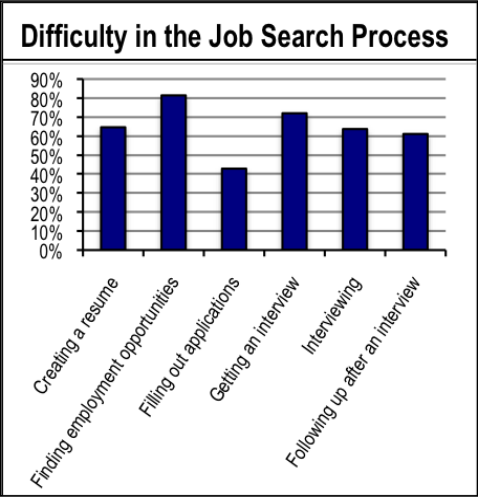
- Finding employment opportunities is the most commonly reported challenge (81%) in the employment process. Other aspects of the employment process were also reported by most as challenging, especially the interview process.
- Regardless of an individual’s skill sets, the social and communication challenges associated with autism affect all aspects of job seeking.
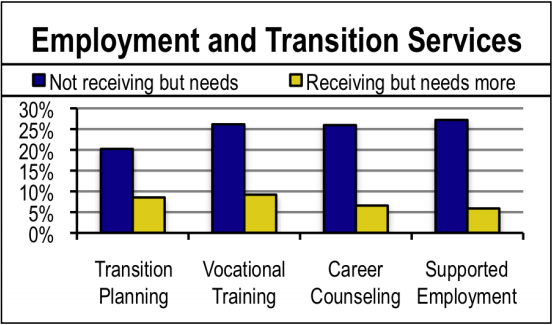
- More than 1 in 4 adults with autism report needing, but not receiving vocational training, career counseling or supported employment, and 1 in 5 report needing, but not receiving help with transition planning.
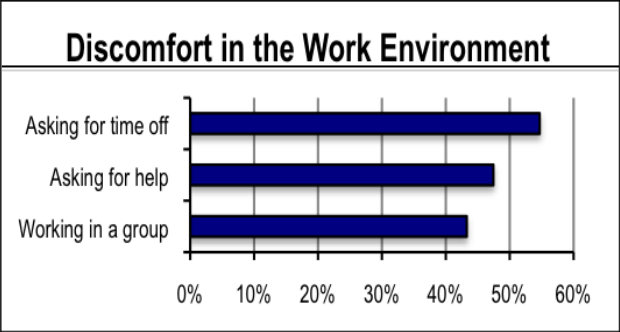
- Almost 70% of those employed feel some type of discomfort interacting with their peers or authority figures in the workplace.
Report #7: Family Impact
Both individuals with autism and their family members need support across the lifespan. Families living with autism face many challenges coordinating services, identifying trained service providers, paying for services, maintaining employment and finding supports for their family. Caring for an individual with autism takes a significant economic and emotional toll on families. This report examines the challenges that families face in caring for an individual with autism.
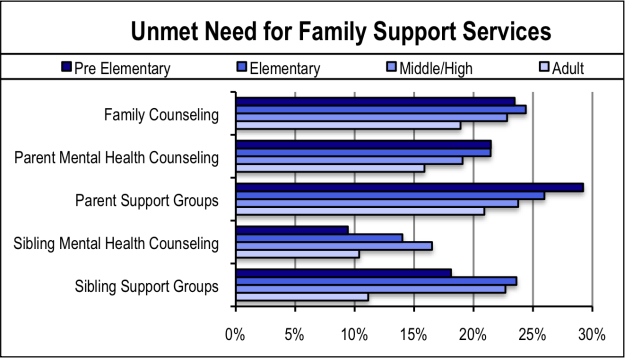
- More than 1 in 3 families reported a need for family support services.
- The most common barriers to receiving these services were a lack or shortage of providers (35%) and high cost or lack of insurance (20%).
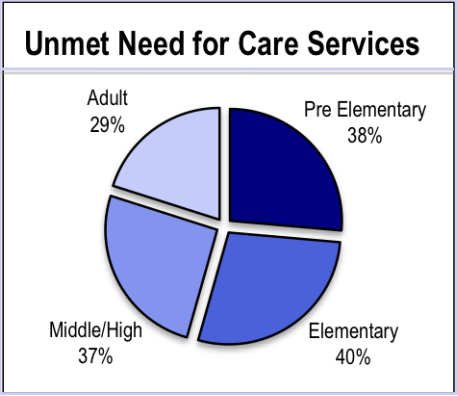
- Across all age groups, caregivers reported an unmet need for care services, such as respite, weekend and after school care.
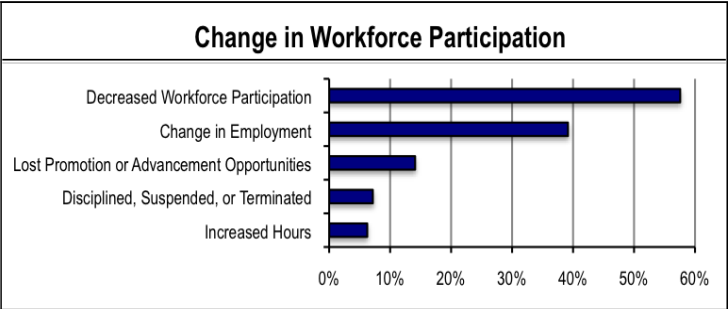
- Over 70% of caregivers or their partner made some change in their workforce participation as a result of having a child with autism, with almost 60% reporting working less.
- Care services support families in caring for their family member with autism in the home and may reduce the likelihood of hospital based care and emergency room use.
While most adults continue to live with their families, the majority of caregivers do not have long-term plans to provide for their family member with autism.